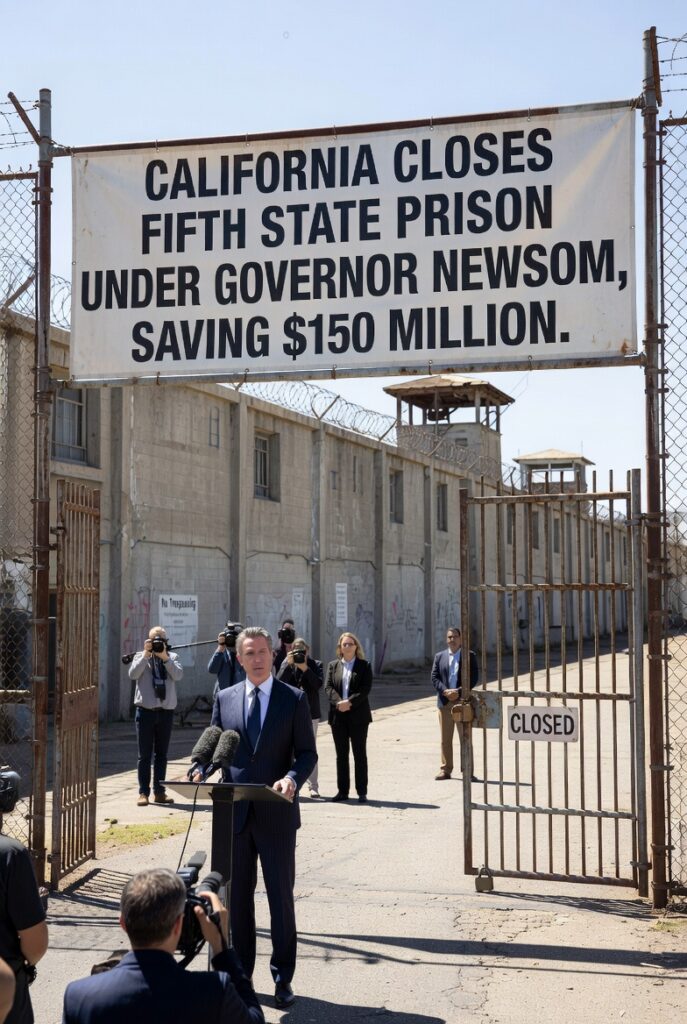
Governor Gavin Newsom’s administration has announced the closure of yet another state prison, marking the fifth facility to be shuttered during his tenure. The prison, a former art deco hotel repurposed as a correctional facility in Riverside County, is slated to close in 2026, with the state expecting to save approximately $150 million from the closure.
A Shrinking Prison Population
As of January 2026, the California Department of Corrections and Rehabilitation (CDCR) was responsible for incarcerating about 90,300 people — a dramatic decline from the system’s peak of over 170,000 inmates in 2006. This reduction has been driven by a combination of criminal justice reforms, court-ordered population caps, and shifting sentencing practices.
The trend has allowed California to consolidate its prison operations, closing facilities that were built during the mass incarceration boom of the 1980s and 1990s. Each closure represents not only budget savings but also a symbolic shift in the state’s approach to criminal justice.
Budget Implications
Despite the declining prison population, California’s corrections budget remains substantial. The Legislative Analyst’s Office has noted that per-inmate costs continue to rise, driven largely by healthcare obligations and staffing expenses. The CDCR currently operates 31 prisons statewide, down from 36 at its peak.
The closure savings are expected to be redirected toward community-based programs, reentry services, and mental health treatment — areas that advocates say are more effective at reducing recidivism than incarceration alone.
Prop. 36 and Shifting Policies
Even as prisons close, California’s criminal justice landscape continues to evolve. The passage of Proposition 36 in 2024 toughened penalties for certain theft and drug crimes, potentially slowing or reversing the population decline in coming years. The measure was a response to public concerns about retail theft and open-air drug markets.
“California is in this interesting push-and-pull,” said a criminal justice researcher at Stanford. “You have a shrinking prison population and prison closures on one hand, but new laws that could start pushing numbers back up on the other.”
Heat and Infrastructure Challenges
For the remaining facilities, infrastructure challenges persist. With temperatures inside some prisons reaching 95 degrees during summer months, advocates have demanded air conditioning installations. The state has responded with a $38 million pilot program to test cooling systems and new insulation at three of its 31 prisons over the next four years.
Browse all 418 California correctional facilities in our directory, including both CDCR state prisons and county jails operated by local sheriffs.
What Happens to Closed Facilities?
The fate of closed prison properties varies. Some have been proposed as sites for housing development, addressing California’s severe housing shortage. Others have been considered for conversion into treatment centers or vocational training campuses. The repurposing of prison land has become a political issue in several communities that depend on prison employment as an economic anchor.